

The Enzo Fernandez Man City move was always going to create headlines, but it wasn’t the £125million fee that caught my attention. It was what Fernandez said after leaving Chelsea.
“I always dreamed of being at a club as big as City.”
Sorry, Enzo. What?
Manchester City are a massive football club. You would have to be ridiculously biased to deny that. They have been a powerhouse of English football for well over a decade and have produced one of the greatest periods of domestic dominance this country has ever seen.
But there is a difference between being the best team and being the biggest club — and I would still argue Chelsea are a bigger name than Manchester City.
Enzo Fernandez Man City comments confuse success with size
What actually makes a football club big?
For me, it’s everything: history, trophies, European pedigree, support, stadium, global recognition, iconic players, iconic matches and the generations of supporters who came before the current team.
Manchester City tick plenty of those boxes now, but you don’t accumulate all of that overnight because you’ve had an incredible 15 years. Club size is something built over generations, not simply during one spectacular period of success.
City have unquestionably been better than Chelsea domestically in recent times. There isn’t really a debate to be had there. Since Sergio Aguero’s famous goal against QPR in 2012, City have turned winning the Premier League into something almost routine.
Chelsea haven’t.
Europe, though, tells a different story.
City’s modern era began with their first Premier League title in May 2012. Six days later, Chelsea became champions of Europe for the first time. Chelsea have since won the Champions League again, two Europa Leagues, the Conference League and twice become world champions.
There is something quite fitting about that timeline: City finally announced themselves as England’s new domestic powerhouse, and six days later Chelsea were lifting the trophy City would spend another 11 years trying to win.
That is the difference between success and pedigree.
Chelsea were feared in Europe before they ever won the Champions League
Chelsea didn’t win the Champions League until 2012, but throughout the 2000s they were already one of the teams nobody wanted to face in Europe.
Think about those Chelsea-Liverpool Champions League battles. Think about Chelsea against Barcelona. Think about Mourinho, Lampard, Terry, Drogba, Cech, Essien and Ballack, or the 2008 Champions League final in Moscow.
Chelsea had become part of the furniture at the sharp end of European football years before they finally lifted the trophy. They had built a European reputation before they had the ultimate prize to show for it.
City’s route was very different. They became a dominant domestic force remarkably quickly, but translating that domination into Europe took considerably longer. Their first Champions League did not arrive until 2023.
That isn’t an attempt to diminish what City eventually achieved. Winning the Treble was extraordinary.
It simply explains why I don’t accept that winning Premier League after Premier League automatically pushes you above clubs that have spent decades building their identity and reputation.
The Enzo Fernandez Man City debate has one awkward European reminder
Then there is Porto in 2021.
I don’t think Chelsea beating Manchester City in the Champions League final settles the entire argument. One match cannot decide which football club is bigger, but it does matter.
On paper, City were probably the better team. They were Premier League champions, packed with world-class players and favourites to win the final.
Chelsea still beat them 1-0 and became champions of Europe. When the biggest prize in European club football was on the line between these two sides, quality shone through in that Chelsea team.
Importantly, this isn’t something that happened in grainy black-and-white footage generations ago. It happened within the last decade.
Fernandez himself then became a world champion with Chelsea in 2025, starting as the Blues beat Champions League holders Paris Saint-Germain 3-0 in the Club World Cup final.
So this isn’t a player leaving some sleeping giant living entirely off its history. He has just left a Chelsea side that became world champions barely a year ago.
The Enzo Fernandez Man City transfer doesn’t suddenly change the hierarchy of English football.
Manchester City aren’t even Manchester’s biggest club
This is where my argument probably becomes even more unpopular with City supporters.
I don’t have Manchester City as the biggest club in Manchester. Manchester United still are.
United haven’t won a Premier League title since Sir Alex Ferguson left in 2013. They’ve made poor decisions, wasted fortunes on transfers and repeatedly looked miles away from challenging City.
They’re still Manchester United.
Twenty league titles. Three European Cups. Generations of supporters around the world and a name that still carries enormous weight.
Even throughout the years when the football has been poor, United have retained enough pulling power to attract some of the biggest names in the game. It hasn’t always worked out for them — sometimes spectacularly — but everybody knows Manchester United.
City have been a much better football team than United for most of the last decade. They still haven’t become the bigger football club in my eyes.
That is why the Enzo Fernandez Man City move raises a much bigger question about how we define club size. If recent success were the only measure, we’d have to redraw football’s hierarchy every five years.
People knew Chelsea before Roman Abramovich
There’s another argument City supporters will inevitably make.
“Chelsea bought their success too.”
Of course Roman Abramovich’s money transformed Chelsea. I’m not going to rewrite history and pretend it didn’t.
But Chelsea did not suddenly appear in 2003.
They won the FA Cup in 1997. In 1998 they won the League Cup, Cup Winners’ Cup and UEFA Super Cup, followed by another FA Cup in 2000. Chelsea had already played Champions League football before Abramovich bought the club.
They had Gianfranco Zola, Ruud Gullit, Gianluca Vialli, Marcel Desailly and Roberto Di Matteo. Chelsea were already a recognisable football name with international stars and a profile stretching far beyond west London.
Maybe some of this comes from my own experience growing up watching football, but people knew Chelsea in the 1990s.
Chelsea had the London pull. They had glamour, recognisable players and European trophies.
Manchester City had history and an incredibly loyal fanbase of their own — I’m not pretending the club was founded in 2008 — but they weren’t occupying anything close to the same space in world football that they do today.
Their transformation has been enormous. In football-history terms, though, that transformation is still incredibly recent.
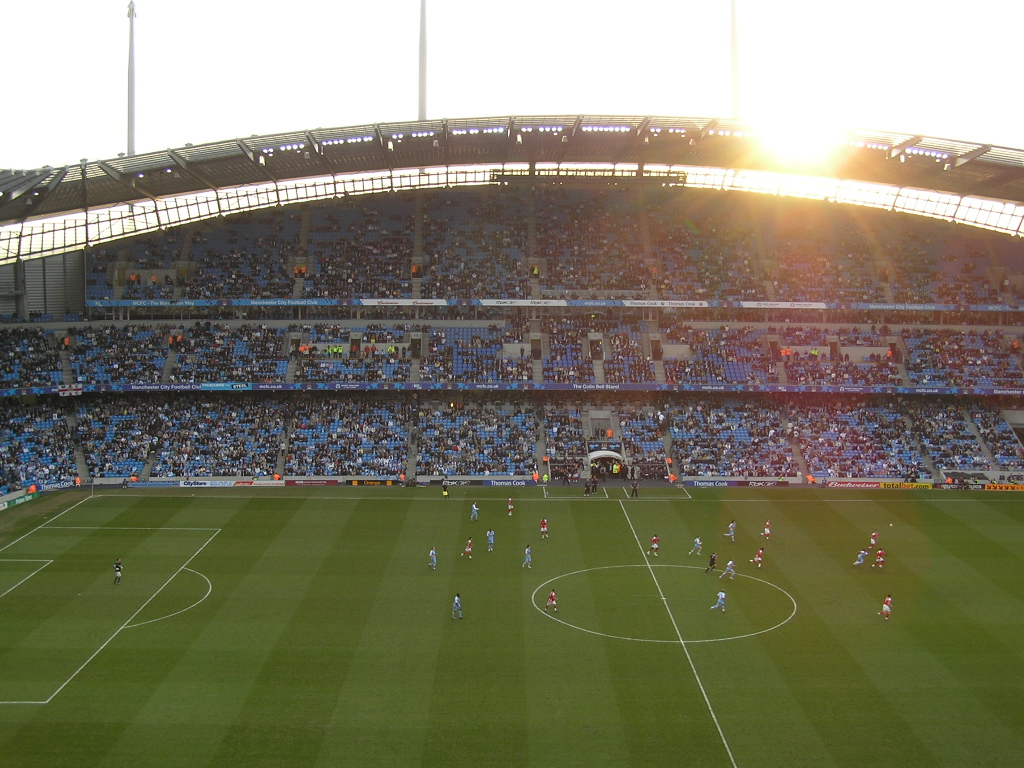
Sunset at the City of Manchester Stadium by Richard Cooke
Stamford Bridge or the Etihad doesn’t settle this argument
City have the bigger stadium and Chelsea supporters will inevitably make their “Emptyhad” jokes. Have your fun.
But capacity isn’t how I decide which club is bigger.
Chelsea have spent years discussing the need for a larger stadium precisely because Stamford Bridge restricts them. Give Chelsea a modern 60,000-seat ground in west London and I’d be fascinated to see the demand.
For me, global support, history, cultural reach and generations of recognition tell us far more about the size of a football club than simply comparing the number of seats inside two stadiums.
It’s the entire package that matters.
My English big-club ranking will definitely upset somebody
If you’re forcing me to rank the biggest English clubs — and yes, there is absolutely some Chelsea bias here — this is where I currently have them:
- Manchester United
- Chelsea
- Liverpool
- Arsenal
- Manchester City
- Tottenham
Liverpool supporters are already typing.
That’s fine. The exact order isn’t scientifically provable because “biggest club” debates never are.
The point is that I don’t believe City’s domestic dominance suddenly puts them automatically above every historic giant of English football. They are building towards that status and maybe one day they get there.
But size takes generations.
Was the Enzo Fernandez Man City move really the dream?
There was plenty of speculation around Real Madrid and Fernandez during the summer, although Madrid themselves publicly denied making an approach or intending to sign him.
Then City came calling and suddenly we’re being told this was the dream.
Maybe it was. Maybe it’s simply what you say when you’ve just joined a new club.
I suppose he had to say something.
But let’s not pretend Enzo Fernandez has escaped little old Chelsea and finally arrived at football’s top table. He’s moved from one huge club to another.
For me, the Enzo Fernandez Man City move is a transfer between two massive clubs — not a player leaving Chelsea to finally reach a big one.
And personally, I’m not even convinced the grass will be greener.
City are undergoing a major rebuild. Pep Guardiola has gone, key players from their great side have departed and Enzo Maresca is putting together something very different.
Chelsea have their own exciting squad and I’ll go further: I think Chelsea have a better chance of winning the Premier League than City this season.
Time will tell whether I’m completely wrong on that one.
City have created an era. Chelsea have created a pedigree
Nobody needs to diminish Manchester City’s achievements to make this argument.
What they’ve done domestically has been incredible. They’ve built one of the greatest English teams we’ve ever seen, finally conquered Europe and transformed themselves into one of the richest and most powerful clubs in world football.
But football clubs aren’t built in 15 years. They’re built over decades and generations.
Chelsea were winning European trophies long before their first Champions League. They were feared across Europe throughout the 2000s, have since won the Champions League twice, completed the set of major UEFA competitions and become world champions twice.
City have created an era. Chelsea have created a pedigree.
So when Enzo Fernandez says he always dreamed about playing for a “club as big as City”, I don’t object to him calling Manchester City big. Of course they are.
I question why he apparently needed to leave Chelsea to find one, because in my eyes he hasn’t joined a bigger club at all.
He’s just left one.